
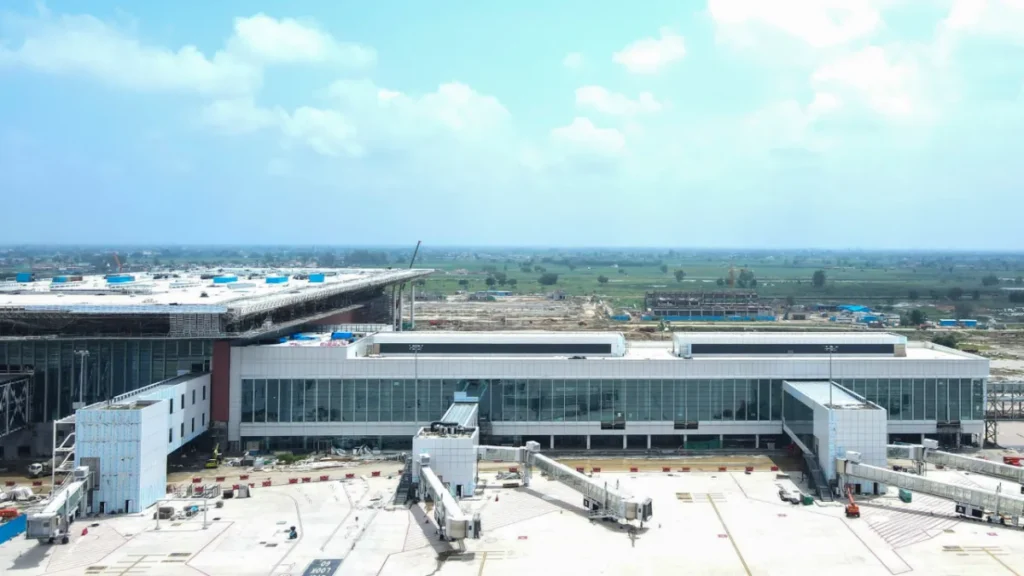
North India just got a new aviation address. Prime Minister Narendra Modi inaugurated Phase 1 of Noida International Airport in Jewar, Uttar Pradesh, on March 28, 2026. The launch marks one of India’s biggest steps in airport infrastructure in years. More importantly, it gives the Delhi-NCR region a much-needed second international gateway.
Why This Airport Matters Right Now
Delhi’s Indira Gandhi International Airport handles a huge share of North India’s air traffic. Congestion has been a long-standing problem for travelers across the region. Now, with Jewar going live, the load finally has somewhere to go.
Phase 1 of Noida International Airport can handle around 12 million passengers annually. That is a significant addition. Furthermore, the airport sits in Gautam Buddha Nagar district along the Yamuna Expressway, putting it within easy reach of Noida, Greater Noida, Delhi, Agra, and Mathura.
The total Phase 1 investment stands at around Rs 11,200 crore under a public-private partnership model. Yamuna International Airport Private Limited, a subsidiary of Zurich Airport International AG, is running the project in partnership with the Uttar Pradesh and central governments. The concession runs for 40 years.
Built for Modern Travel
The airport features a 3,900-meter runway capable of handling wide-body aircraft, including the Boeing 777-300ER. That means long-haul international routes are fully within reach from day one. Advanced navigation systems and upgraded airfield lighting also support round-the-clock operations, even during North India’s notoriously dense winter fog.
Inside the terminal, the focus is on speed. Self-service kiosks, digital check-in, and biometric verification all aim to reduce queues and processing time. The design draws inspiration from India’s cultural heritage, incorporating elements from the ghats of Varanasi and Haridwar.
Additionally, a dedicated Maintenance, Repair, and Overhaul zone covering about 40 acres forms part of the project. This means airlines can service aircraft locally rather than sending them overseas, reducing costs and building India’s aviation support capacity.
Connectivity That Goes Well Beyond the Runway
Road access is already strong. Direct links via the Yamuna Expressway connect the airport to Delhi, Noida, and Greater Noida. Future connections via the Delhi-Mumbai Expressway will extend reach into Haryana and western India. The Ganga Expressway and Eastern Peripheral Expressway will further connect cities such as Ghaziabad, Meerut, Palwal, and Sonipat.
Rail plans are equally ambitious. A Regional Rapid Transit System connecting Delhi to Jewar is under proposal. On top of that, planners have included a Jewar station in the proposed Delhi-Varanasi High-Speed Rail corridor. Together, these links will make the airport accessible to hundreds of millions of people across North India.
IndiGo will serve as the launch carrier, with Akasa Air and Air India Express also expected to begin services shortly after opening. Commercial flights and cargo operations are set to start by mid-April 2026. Discussions with additional domestic and international operators continue.
Noida International Airport targets net-zero emissions. The facility uses solar power, rainwater harvesting, and energy-efficient building design. Natural lighting reduces power consumption across the terminal. These features place it among the more environmentally aware airports in Asia at launch.
Beyond its green credentials, the airport also includes an integrated cargo terminal with an initial capacity of over 2.5 lakh metric tonnes annually. That serves exporters, manufacturers, and e-commerce companies that need reliable logistics out of the NCR region.
Long-Term Vision: 70 Million Passengers by 2036
Phase 1 is just the start. By 2036, expansion plans aim to push total capacity to 70 million passengers annually. That would put Jewar Airport in the same league as some of the world’s major hubs.
For now, though, the immediate priority is straightforward. Shorter queues at Delhi airport. Faster check-ins. Better access for travelers across western Uttar Pradesh, Haryana, and Uttarakhand. And a genuine second option for one of the world’s most congested aviation zones.
North India’s skies just got a little less crowded.