
The ongoing conflict in Iran is hitting the global travel industry hard. The World Travel & Tourism Council estimates losses of at least $600 million per day in international visitor spending across the Middle East. That number is not a projection. It is happening right now.
The Middle East Sits at the Heart of Global Transit
The Middle East handles 5% of global international arrivals and 14% of global transit traffic. So any disruption there hits airlines, hotels, cruise lines, and car rental companies far beyond the region.
Major aviation hubs in Dubai, Abu Dhabi, Doha, and Bahrain collectively process around 526,000 passengers per day under normal conditions. But right now, many of those hubs are shut or running at a fraction of capacity.
Flight Cancellations Cross 56%
The scale of cancellations is staggering. Since late February, operators have scheduled over 51,000 flights across the Middle East. Carriers cancelled more than 29,000 of them, pushing the disruption rate past 56%.
In Doha, airlines cancelled 288 out of 308 departures. Bahrain recorded 92 out of 93 cancellations. That is a near-total shutdown.
On top of that, at least eight countries simultaneously declared airspace closures: Iran, Israel, Iraq, Jordan, Qatar, Bahrain, Kuwait, and the UAE.
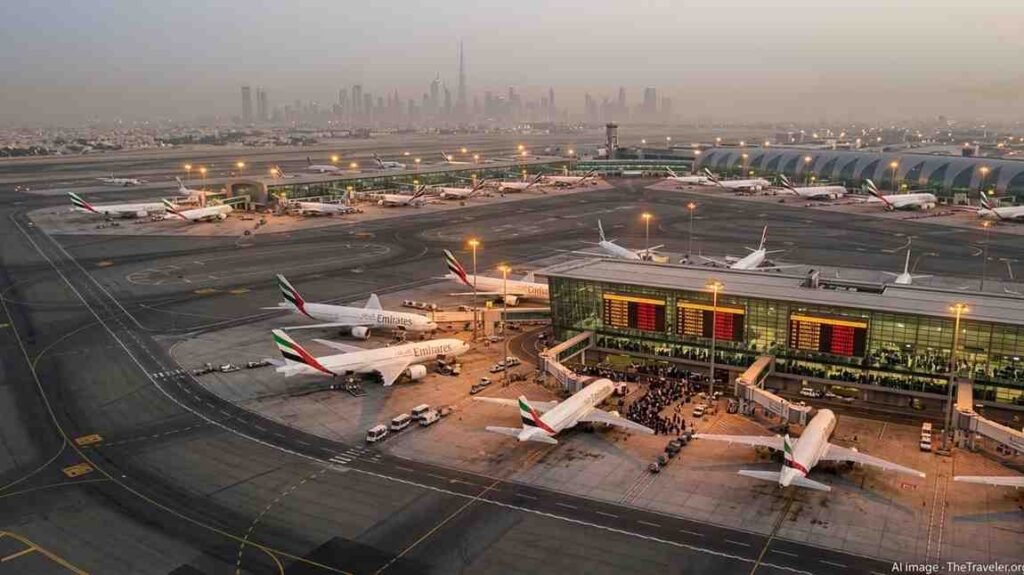
At least 90,000 passengers transit daily through Dubai, Doha, and Abu Dhabi on Emirates, Qatar Airways, and Etihad Airways alone. Thousands of those travellers are now stranded.
As a result, airports in London, Mumbai, Delhi, Bangkok, Istanbul, and Paris each reported dozens of cancellations as a ripple effect. This is not a regional problem. It is a global one.
India feels the impact directly. Indian travellers, workers, and transit passengers, depending on Gulf hubs, face major disruptions. Airports across South Asia reported stranded passengers after flights to Dubai and Bahrain stopped running.
The Economic Damage Runs Deep
The WTTC built its analysis on a pre-conflict 2026 forecast projecting $207 billion in international visitor spending across the Middle East this year. That forecast now looks increasingly unlikely to hold.
Moreover, Dubai set a new tourism record in 2025, welcoming 19.59 million international overnight visitors and achieving over 80% hotel occupancy. That momentum has now stalled.
Recovery Is Possible, But Slow
Research shows tourism demand following security-related incidents can bounce back in as little as two months when governments and industry move quickly. Clear communication and strong coordination between the public and private sectors are critical to rebuilding traveller confidence.
In response, the UAE opened designated safe air corridors to allow limited flights to operate. Several Gulf carriers also started cautiously rebuilding operations. Etihad resumed a limited schedule from Abu Dhabi, and Emirates brought back a reduced network from Dubai.
However, a full recovery is not imminent. Aircraft are out of position across multiple continents, crews are displaced, and hub schedules that took years to build are now broken. Restarting takes time.
The conflict continues. The meter is still running.