
The alarm went off at 5 AM, but honestly, I didn’t need it; I was already wide awake. Outside my window in Ahmedabad, the sky was still dark, but hundreds of glowing tukkals, those paper lanterns tied to kite strings, drifted up like stubborn stars that just wouldn’t disappear. It was my first Uttarayan, the famous kite festival in Gujarat, and the whole city seemed to come alive. I heard people shouting “Kai Po Che!” from the rooftops, bragging about cutting someone’s kite. Over the next few days, I saw something I didn’t expect. The way people celebrated, came together, and just shared pure happiness changed how I thought about festivals and, honestly, about community itself.
Plan Your Trip With These Guides:
Best Places to Visit in Konkan 2026: Beaches, Hill Stations & Hidden Gems
Somnath Travel Guide: Temple Timings, Hotels, Route & Travel Tips
Goa Trip on Low Budget: How to Plan a Cheap Trip in 2026
Festival Overview: A Cultural Phenomenon
Here are some key details of the festival that you should know:
| Aspect | Details |
|---|---|
| Festival Name | Uttarayan (International Kite Festival) |
| 2026 Dates | January 10-14 across Gujarat |
| Main Venue | Sabarmati Riverfront, Ahmedabad (Jan 12-14) |
| Significance | Marks Makar Sankranti, sun’s northward journey |
| Origin | Over 1000 years old; International Festival since 1989 |
| Participants | 40+ countries, including Japan, Malaysia, USA, China, Italy |
| Daily Activity | Dawn to past sunset kite flying |
A Festival Born from Tradition
Kites first showed up in India more than a thousand years ago, brought by Muslim traders from Persia or Buddhist pilgrims from China who came searching for sacred texts. The composer Santnambe sang about kites ages ago, and old miniature paintings show people flying them across different eras. But Gujarat stands out, not just for flying kites, but for turning this tradition into a lively mix of cultures.
Gujarat sits at the far western tip of India, where Muslim and Hindu traditions have mixed together for ages. That mix gave the state something special: kites. Muslims probably brought them here, and now they’re a huge part of Uttarayan, the Hindu festival that marks winter turning into summer. These days, everyone joins in. Religion doesn’t matter; it’s all about flying kites and celebrating together.
The Morning That Never Ends
I found myself on a rooftop in Ahmedabad’s old city, and what I saw was wild. Kids who usually grumble about waking up for school set their alarms for 5 AM, just to catch that perfect pre-dawn wind for flying kites. Whole families showed up, arms full of thermoses of masala chai and plates stacked high with undhiyu, laddoos, and surati jamun. The energy was something else; nobody wanted to miss a moment.
The whole place buzzed with excitement. Neighbors turned into both rivals and teammates, trying to slice each other’s kite strings but still swapping tricks and passing around snacks. Everyone’s eyes stayed on the sky, where the real action happened. They used manja, that sharp, glass-coated string, to try to cut down anyone else’s kite drifting too close.
The International Spectacle
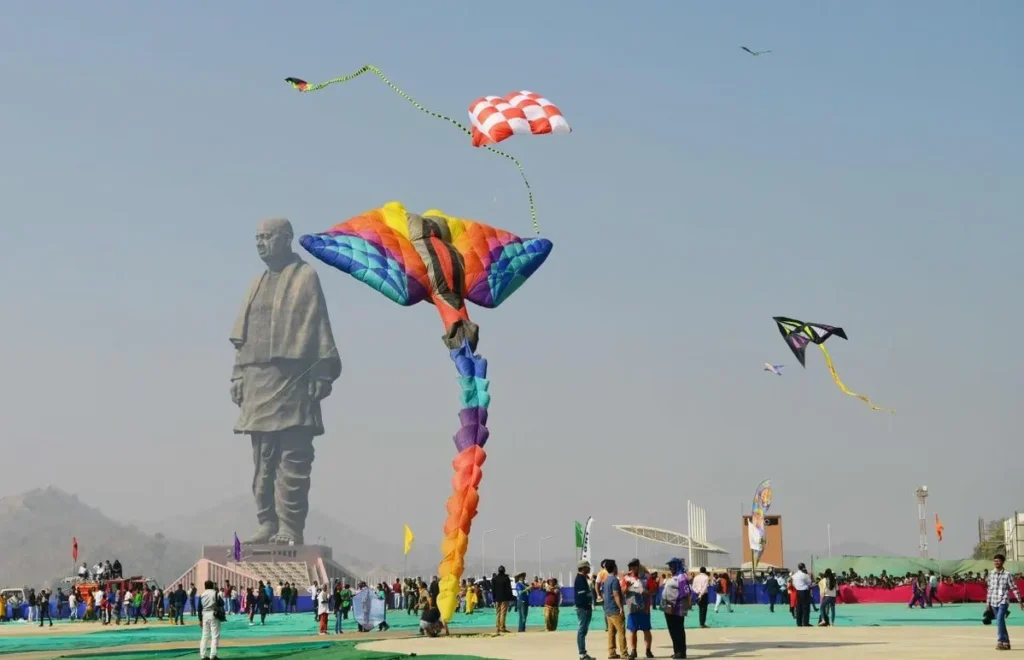
Since 1989, Ahmedabad’s International Kite Festival has pulled in top kite makers and flyers from across the globe, all eager to show off their wildest designs. In 2026, the festival kicks off on January 10th in Rajkot, Surat, and Dholavira. Then, on January 11th, the action moves to Shivrajpur, the Statue of Unity, Ektanagar, and Vadnagar. But honestly, the real highlight lands in Ahmedabad, where the big celebration lights up the Sabarmati Riverfront from January 12th to 14th.
As I wandered around the festival, kites from all over the world caught my eye. The Malaysian Wau-Balang kites stood out with their beautiful patterns. Nearby, the Japanese Rokkaku kites darted and danced in the air; those flyers really knew what they were doing. Indonesian Llayang-Llayang kites turned heads, and the Chinese dragon kites: wow, those stole the show. American kite lovers came in with massive banner kites that filled the sky, while the Italians showed off sculptural kites that brought a modern twist to the whole scene.
The 2026 venue has a Heritage Pavilion packed with displays that bring Ahmedabad’s old “Pols,” those tight-knit housing clusters, to life. There’s even a whole Kite Museum. But honestly, what really got everyone talking was Rasulbhai Rahimbhai. He’s the guy who can fly 500 kites at once, all on a single string. Pulling that off takes great skill and a deep feel for how the wind moves.
The Food of Celebration
Uttarayan just isn’t the same without its classic foods. All day long, rooftops turn into makeshift kitchens. Families gather to cook undhiyu, a dish that takes real effort, packed with seasonal veggies, beans, and yams, all slow-cooked the old-fashioned way, buried underground. Jalebi and fafda are everywhere. Seriously, people eat that sweet-and-savory combo morning, noon, and night.
Street vendors hand out sesame seed brittle, chikki, sticky with jaggery, a quick bite that somehow makes the day feel sweeter. Gulab jamun, laddus, and dhokla all make the rounds as neighbors wander from terrace to terrace. Someone’s always pouring hot masala chai, keeping everyone warm and a little wired while kites dart across the January sky.
Beyond Religious Boundaries
What really got me was how inclusive the festival felt. Sure, Uttarayan started with the Hindu calendar, but now, everyone in Gujarat jumps in, no matter their background or beliefs. You’ll see Muslim families flying kites right next to their Hindu neighbors. Christian visitors head up to the rooftops to join the fun. Even Sikh communities throw their own celebrations. It’s like the whole place comes together.
People come from all over India for this festival. Gujaratis living overseas often plan their trips home just to be here. You’ll even spot international visitors from places like Japan, Italy, the UK, Canada, Brazil, Indonesia, Australia, the US, Malaysia, Singapore, France, and China, and honestly, the list goes on.
How to Plan Your First Kashmir Trip in 2026
The Magic After Dark
When the sun dipped down, I figured the festival was wrapping up. Nope. That’s when everything changed. Suddenly, kite fighters were sending white kites soaring so they’d stand out in the dark, and others started launching tukkals, these special kites trailing strings of glowing lanterns. Those lights stretched all the way back to the rooftops. The whole sky turned into a shifting map of colors and movement, while folk music played and people everywhere kept shouting, “Kai Po Che!”
As the sun goes down, kites start to glow, and the sky fills with Tukkals, those paper lanterns tied to kite strings. It looks like a galaxy drifting right over Ahmedabad. Standing there, watching thousands of lights flicker and float, I finally got it. No wonder people around here mark time by Uttarayans. They’ll say, “Hey, didn’t we meet three Uttarayans back?” And honestly, it just makes sense.
Practical Wisdom for Visitors
Kite makers in Ahmedabad get to work in November, setting up shop on the city’s streets. Patang Bazaar, the old city’s famous kite market, doesn’t sleep during the week before the festival; it’s open around the clock. The best part is that kites are so cheap that just about anyone can join in.
You don’t need a ticket to get into the International Kite Festival at Sabarmati Riverfront; entry’s free for everyone. The best time to go: Show up around 10:00 AM when things really get going. Just a heads-up: bring sunglasses and a scarf to guard against manja (that sharp, glass-coated kite string). And don’t forget sunscreen; after a few hours of staring up at the sky, you’ll be glad you did.
Cultural Significance Today
The International Kite Festival started back in 1989 on the banks of the Sabarmati River in Ahmedabad. It’s wild to think that what once was just a local event now pulls in kite flyers from more than 40 countries. The Gujarat government spotted how much people love kite flying and turned it into a big draw for cultural tourism.
This festival means a lot of things: freedom, togetherness, and pure joy, and it shows everyone that the harvest season’s here. Farmers look forward to it because the sun starts moving north, days stretch out, and the warmer weather does wonders for their crops. People in the city get a break, too. It’s a chance to step away from the daily grind, meet up with family and friends, and just enjoy life outdoors.
Explore International Trip:
Tomorrowland Thailand 2026: How to Pre-Register Online
Thailand Travel Guide 2026: Your Dream Tropical Escape
My Lasting Impression
On my last night there, I found myself standing on a rooftop, watching the sun set and splash orange and pink across the sky. Hundreds of kites still darted overhead. Next to me, a grandmother, who’d seen 70 Uttarayans, grinned and said, “This festival reminds us that just being alive together is reason enough for joy.”
She nailed it. Uttarayan isn’t just about kites, or who wins, or tradition for tradition’s sake. It’s about whole neighborhoods stopping to look up. People play together, swap snacks and stories, try to slice each other’s kites out of the sky, then scramble to help strangers chase down the ones that fall. Kids watch and learn from the old pros. Travelers from around the world get pulled into the fun on someone’s roof. The entire state throws itself into one huge, wild celebration.
Whether you show up as a visitor or you’re coming home to Gujarat, Uttarayan pulls you in. It doesn’t matter who you are or where you’re from; if you’re here in January, you end up with a kite string in your hand.
Every year, Gujarat’s sky turns into a wild, living canvas, painted by millions of hands, each one holding tight to a bit of string, chasing dreams, holding tradition, and just wanting to fly.